Lenke classification of adolescent idiopathic scoliosis
The Lenke classification sorts the curve pattern of adolescent idiopathic scoliosis into one of six types, with a lumbar modifier (A, B or C) and a sagittal modifier (−, N or +). It was published in 2001 as a classification “to determine extent of spinal arthrodesis”. (Lenke 2001)
The curve type, 1 to 6
The six types are: 1 main thoracic, 2 double thoracic, 3 double major, 4 triple major, 5 thoracolumbar/lumbar, and 6 thoracolumbar/lumbar – main thoracic. (Lenke 2001)
- The major curve is always structural. It is the one with the largest Cobb angle; if the main thoracic and the thoracolumbar/lumbar curves measure the same, the thoracic one.
- A thoracolumbar/lumbar curve leads a type 6 only if it measures at least 5° more than a structural main thoracic curve. With less than 5° between them the two are a double major, type 3 (type 4 if the proximal thoracic curve is structural too).
Structural minor curves
A minor curve is structural if its angle on the bending film is 25° or more, or if its regional kyphosis is +20° or more. The kyphosis is measured T2–T5 for the proximal thoracic curve and T10–L2 for the others. (Lenke 2001)
This is why the bending films matter: without a bending, a minor curve can only be judged on its standing angle.
The lumbar modifier: A, B or C
The modifier comes from the position of the central sacral vertical line against the apex of the lumbar curve. As the paper defines it on the film: C when the sacral vertical falls beyond the lateral margin of the apical body, B when it touches the apex between the medial border of the pedicle and that margin, and A while it runs between the pedicles. (Lenke 2001)
The sagittal modifier: T5–T12
The thoracic kyphosis from T5 to T12 gives the sagittal modifier: under +10° is hypo (−), +10° to +40° is normal (N), over +40° is hyper (+). (Lenke 2001)
How ScolioSim classifies
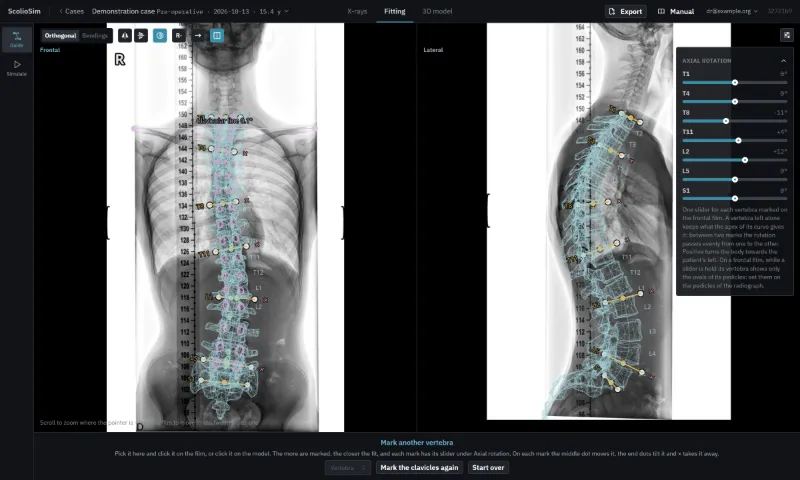
- Load the standing frontal film and the side-bending films, and fit the model to them in Guide, Fitting. Cobb angles can also be drawn by hand with the Cobb tool in Simulate, 2D: click the two ends of a line along the endplate of each end vertebra.
- ScolioSim reads the angle of each segment standing and on each bending, and applies the criteria above: the major curve structural by definition, minor curves structural by bending angle or regional kyphosis, and the 5° rule for type 6.
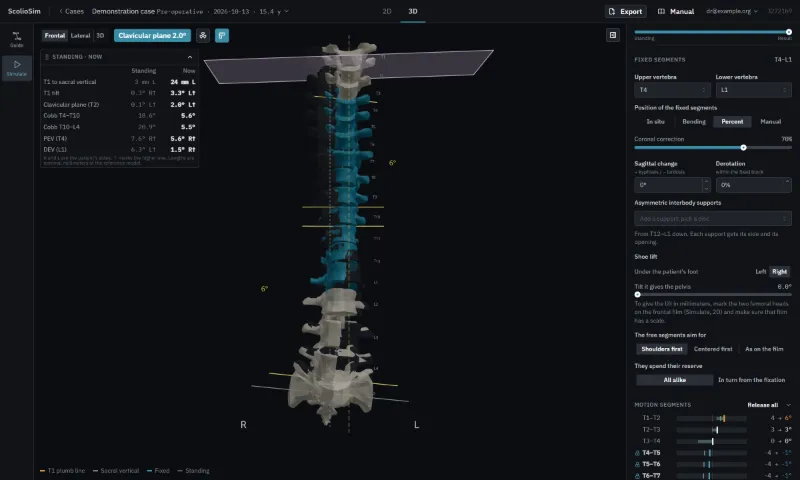
- The lumbar modifier is worked out on the 3D model as the paper defines it on the film.
- The type appears in the Coronal curves block of the 3D model panel and in the PDF report.
If a minor curve lacks its bending, the type is marked provisional (a question mark next to it), because that curve was judged on its standing angle.
ScolioSim classifies the curves; it does not choose the levels of a fusion, and it does not forecast how a patient will stand afterward. The choice stays with the surgeon.
Measure, plan and simulate on your own radiographs, in the browser. Nothing about a patient or a case is stored on a server.
Try it in ScolioSim — freeReferences
- Lenke LG, et al. (2001). Adolescent idiopathic scoliosis: a new classification to determine extent of spinal arthrodesis. J Bone Joint Surg Am. PMID 11507125